The Patizon ReLight Pro Down Jacket is a hybrid insulated jacket designed for lightweight warmth and high mobility. It combines premium European goose down with synthetic Climashield Eco insulation and focuses on freedom of movement, breathability, and sustainable materials.
Main specs
- Weight: 380,9 grams S (Claimed 381 grams size M)
- Packsize: 131 x 240 mm
- Insulation: European 90/10 goose down 850 cuin fill power combined with Climashield Eco synthetic insulation
- Outer material: Pertex Quantum 100% recycled nylon with DWR treatment
- Price: € 345.00 On sale currently for € 241.50
I have been using the Patizon ReLight Pro Down Jacket for almost two years. There is a reason for this almost overdue review; winters in the Netherlands are getting warmer and I did not travel much to the Alps in winter lately. Nevertheless I do think that I have enough cold weather experience by now to write this review.
About the brand
For two years I had never heard about Patizon and it was introduced to me by the Dutch distributor and Patizon sent me the test jacket. Patizon is an outdoor gear brand that originated in the Czech Republic. The company started out focused on designing lightweight, functional down sleeping bags for hikers, backpackers, and mountaineers, with an emphasis on quality materials, precise construction, and careful environmental consideration. Over time, Patizon expanded its range to include insulated jackets like the ReLight Pro, while maintaining the same values of durability, sustainable materials, and practical design. All of their products are manufactured locally in the Czech Republic using premium components such as Pertex and Toray fabrics, and the brand places a strong focus on responsible sourcing, including RDS-certified down and recycled materials throughout its range.


Size and weight
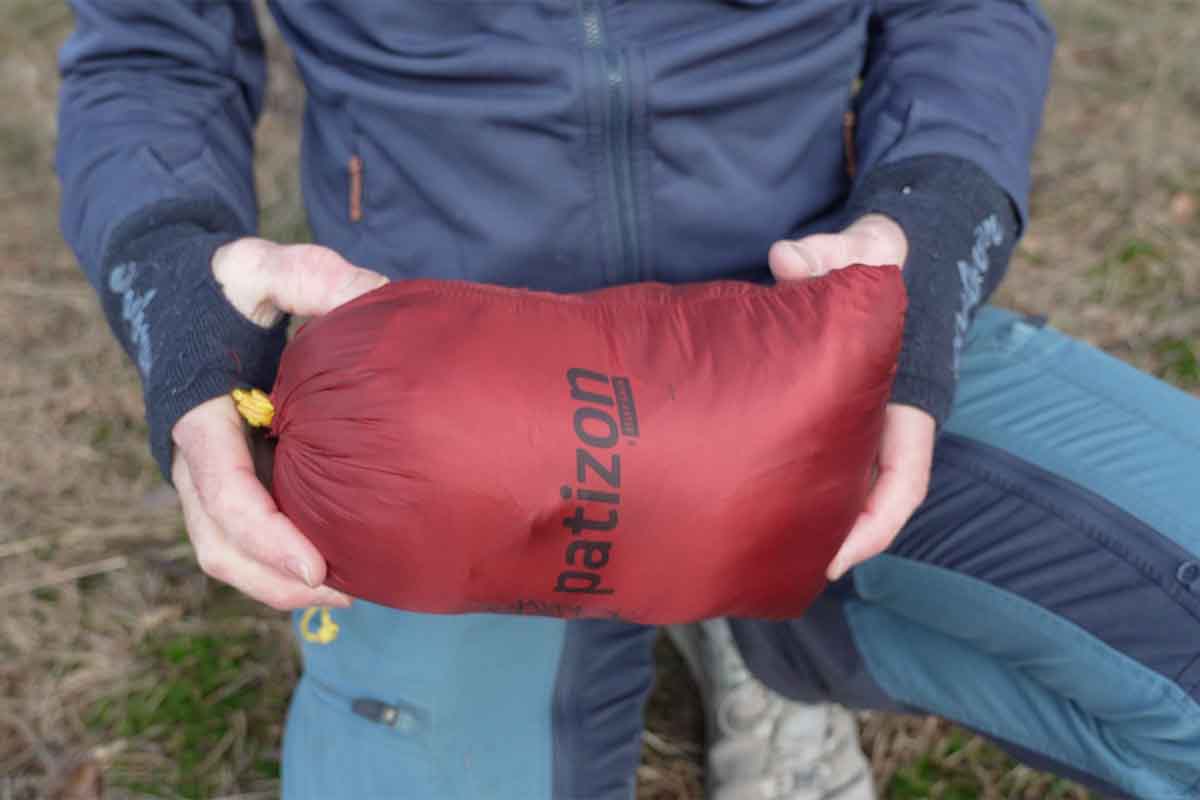
One of the main advantages of down insulation is its excellent compressibility, and the ReLight Pro makes good use of that. I measured a weight of 380,9 grams in size S on my calibrated scale. Patizon claims a weight of 381 grams in a men’s size M so they are quite close. The weight is fine for a jacket with this level of insulation. Packed into its stuff sack – weight a mere 7.8 grams – I measured a packsize of 131 x 240 mm. That means it takes up very little space in my backpack and it is easy to carry on hikes or trips where it may spend most of the time packed away. Once taken out, the jacket lofts quickly and reaches its full insulating volume without much waiting, which is exactly what you want during cold breaks or in camp.
Hybrid Insulation
Instead of using down throughout the entire jacket, Patizon chose a hybrid insulation approach. Premium European goose down is used in the core areas where warmth is most important, while Climashield Eco synthetic insulation is placed in areas more exposed to moisture and movement, such as under the arms, around the hood, and in the lower back. This construction improves moisture resistance and breathability and avoids the need for stitched baffles in those zones, which also helps with comfort, freedom of movement and…is maybe a bit more cost efficient in production.
But there is more to tell about the down.
When it comes to down, there are two questions that always come up: What type of down is it? And what is the quality of that down? Let’s go through both of these questions one by one.

First, what type of down are we dealing with? Is it from geese or from ducks? This question used to carry a lot of weight because many people believed that goose down was inherently superior to duck down. Today, however, experts agree that while goose and duck down do look different, they can still provide the same level of insulation. In other words, the species of origin matters far less than the actual insulation performance, which is measured by fill power. The real answer to how good a down is, comes from the next question: its quality.
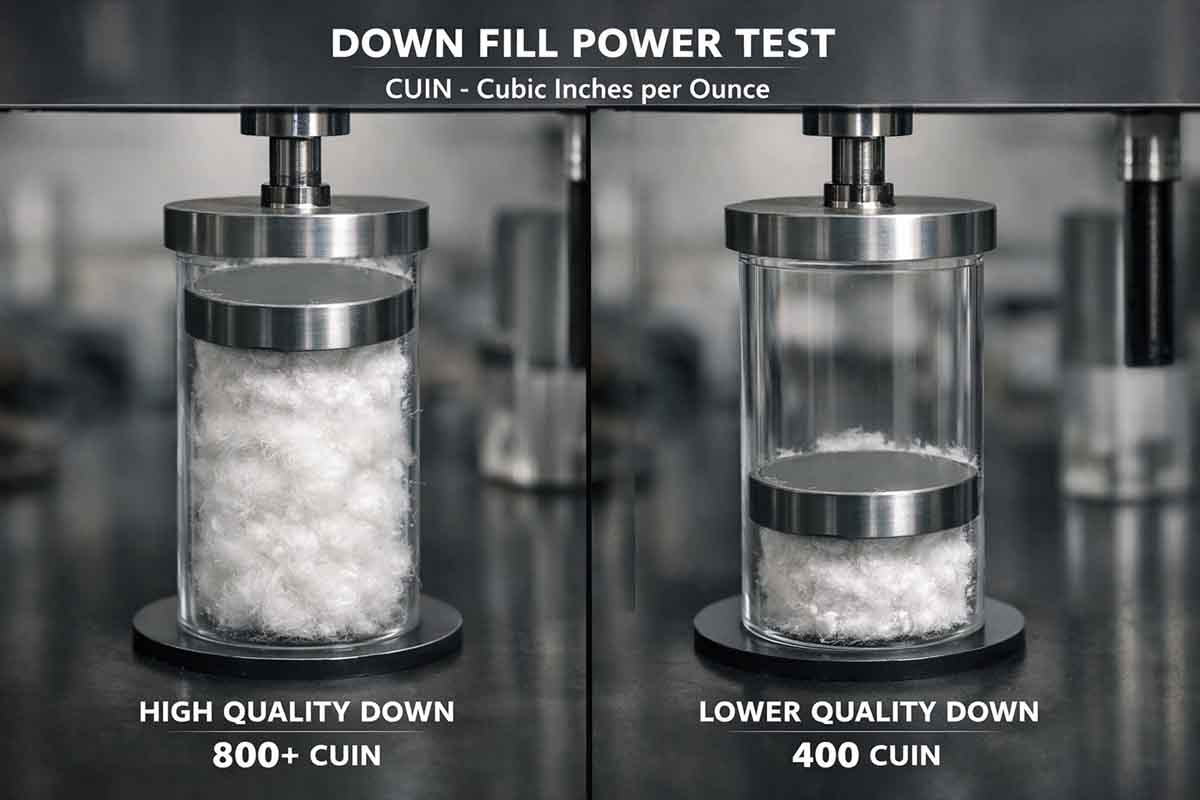
So, what determines the quality of down? The quality is expressed as Fill Power, often abbreviated as FP, and measured in cubic inches per ounce, or CUIN. How is this done? In a standard test, a fixed amount of down—typically one ounce—is placed in a transparent tube marked with a scale. A weight is then applied on top of the down, compressing it. High-quality down, which traps a lot of air, resists compression and collapses less under the weight. Lower-quality down, which traps less air, compresses more easily. Fill power therefore gives a clear indication of insulation capability. As a rough guide, down with a fill power of 440–450 CUIN is considered average, 500–550 CUIN is good, 550–750 CUIN is very good, and anything above 750 CUIN is top-tier, representing the best insulation available.
The goose down used in the Patizon ReLight Pro Down Jacket has a fill power of 850 CUIN. This places it at the almost very top end of what is available in down, offering excellent insulation performance with only a ‘small’ amount of down.
RDS-Down
The down in the Patizon jacket is RDS-certified. This might need some explanation of what the Responsible Down Standard (RDS) is. The Responsible Down Standard (RDS) is one of the most important certifications when it comes to down and was developed by the Textile Exchange organization.
The Responsible Down Standard ensures that the down used in your clothing comes from ducks and geese raised on farms where animal welfare is guaranteed. The pillars on which the RDS label is based include: respecting animal welfare, ensuring that animals are not force-fed, that they are only plucked after slaughter, that the production process is monitored by an independent third party, and that farmers, animal welfare experts, brands, manufacturers, and retailers are all involved. Only when all these conditions are met, may a product carry the RDS label. In my opinion the use of RDS-down is not only a pro, it’s better not to buy non-RDS-certified down products. It is the minimum we can do.
Fabric material
Both the outer and inner fabrics are made from recycled nylon, using Toray Airtastic and Pertex Quantum materials. A DWR-coating (more on this below) is applied to help shed light moisture and snow. As with all down jackets, this does not make the jacket waterproof, but it should offer enough protection for dry cold conditions and light precipitation. In prolonged wet weather – not the intended use of a down jacket – a shell layer is advised.
DWR-coating: Waterproof or water resistant?
Most down jackets are not designed to be full rain jackets, but they still need to provide a certain level of water resistance to function effectively in light moisture or damp conditions. Just melting snow can be a limiting factor… The Pertex Quantum and Toray Airtastic outer materials, for example, are treated with a DWR coating. DWR stands for Durable Water Repellent, and it is applied to the fabric to help water bead up and roll off, rather than soaking into the jacket. The DWR coating used on the fabrics of the ReLight is free of PFCs. PFCs, or PerFluorocarbons, are chemicals that have been shown to contribute to environmental harm, including ozone layer depletion.

In recent years, it has become possible to produce DWR coatings that are free of PFCs, which are more environmentally friendly. However, these alternatives currently tend to be less durable over time compared to PFC-based treatments. The DWR-coating on the Patizon is guaranteed for 80% efficiency after 20 wash cycles. That’s a number I’ll never reach but it is definitely a pro in relation to durability and sustainability. If you want to restore it to 100% again just clean and impregnate the jacket.

No hydrophobic down
When it comes to the down inside the jacket, the situation is quite different. The raw down is cleaned in the factory by a biodegradation process. This cleaning is needed because raw down smells and we don’t like this. By cleaning some of the natural hydrophobic properties of the down are removed. While the majority of outdoors brands treat the down after cleaning to make it fully hydrophobic again, Patizon does not do this and they have a good reason for this.
Natural down has the ability to absorb a small amount of moisture – sweat or humidity – into its structure without immediately losing its insulating properties. That’s one of the reasons a down sleeping bag or jacket often feels more comfortable and has a better internal climate than a synthetic one. Of course, there is a trade-off. If down gets completely soaked – for example in heavy rain – it will clump together, lose its loft, and take a long time to dry. That’s the classic weakness of natural down.
Hydrophobic down addresses part of this issue by repelling moisture, but it comes with its own compromises. Patizon explained that with applying a hydrophobic treatment the down loses some fill power and that they do not know what a treatment will do in the long term with the down. Since Patizon wants to make a product with a long lifespan they have chosen this different approuch.
Baffles
In the jacket, the down is kept securely in place using relatively straightforward sewn-through baffles. This means that the outer fabric and the inner lining are stitched directly together, creating narrow channels or “tubes” that hold the down in position. This type of construction is simple and effective, ensuring that the insulation does not shift around inside the jacket during use.
One inherent aspect of sewn-through baffles, however, is the creation of thermal cold bridges. These occur at the seams where the outer and inner fabrics are in direct contact with each other and no down is present. In theory, these areas could allow heat to escape more easily, reducing the overall insulation slightly at those points.
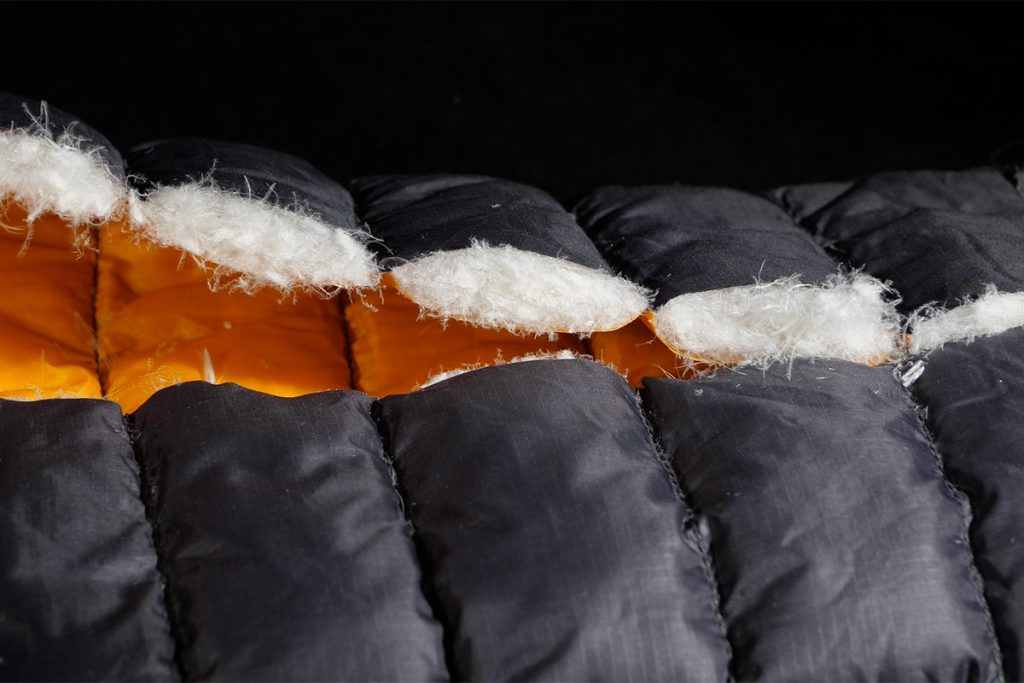
In the case of the ReLight Pro Jacket, these cold bridges are barely noticeable. This is thanks to two key factors: first, the baffles are well filled with down, ensuring that there is minimal gap along the seams. Second, the pocket construction on front of the jacket ensures big parts are covered with more than one extra layer over the baffles. This design detail helps maintain consistent warmth across the front of the body, preventing noticeable cold spots and improving the overall thermal efficiency of the jacket.
Fit
The fit of the ReLight Pro is designed with movement in mind. The raglan sleeve construction allows for a natural range of motion, whether hiking, scrambling, or wearing a backpack. The jacket leaves enough room for base and mid layers without feeling bulky. Elasticated sleeve ends help keep warmth in, and the adjustable hem (elastics with toggles) allows you to seal the jacket when temperatures drop.
Hood
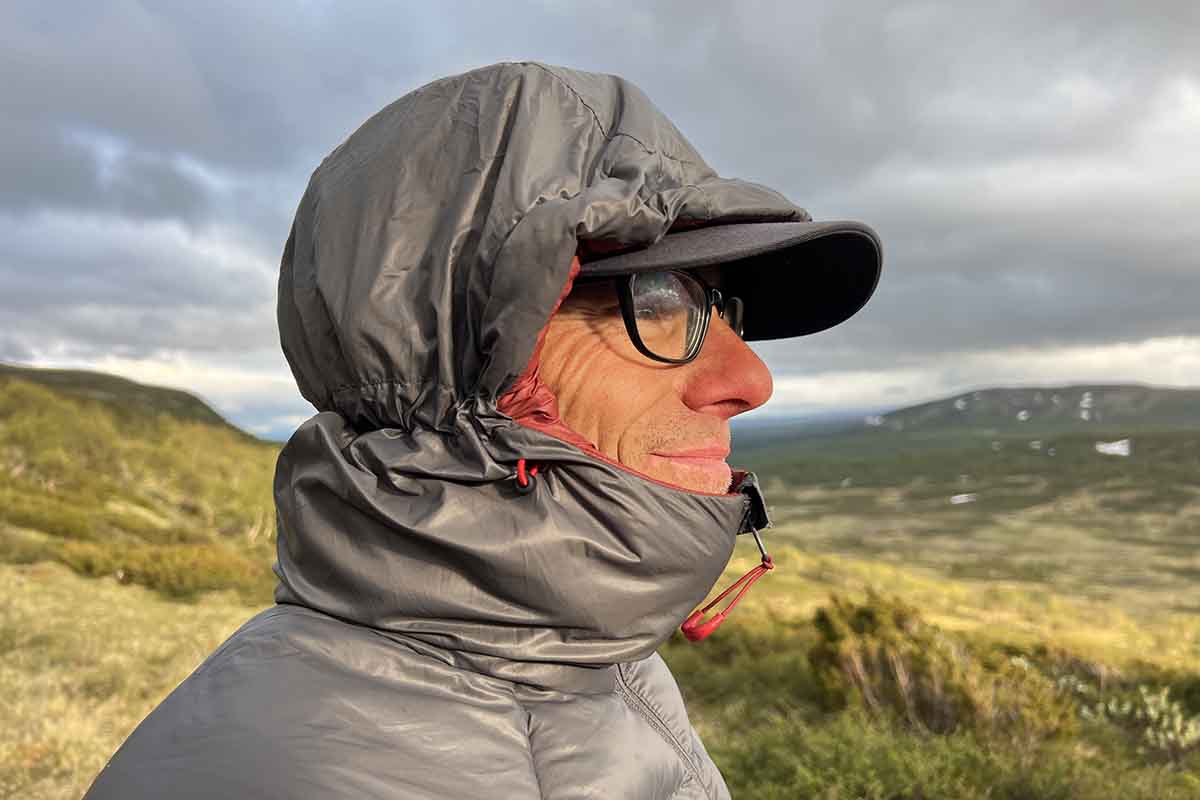
The hood is helmet compatible and adjustable, offering good protection against wind and cold. The adjustment cords are discreetly integrated, keeping the overall design clean and preventing loose cords from flapping in windy conditions. This makes the hood practical for both outdoor use and everyday wear. Wearing spectacles or goggles is not a problem. The hood has a peek that works quite nicely but sometimes wearing a cap underneath is a solution when it is snowing and you are – like me – using prescription glasses.


Pockets
Storage is well thought out. The jacket features two hand pockets lined with merino wool for extra comfort, a zippered chest pocket, and two internal pockets suitable for gloves or other small items. The zippers are smooth and easy to operate and all in all these details add to the overall feeling that the jacket was designed by people who actually use their gear outdoors. Except for one tiny flaw. The zippers miss decent pulling tabs and using them with gloves is tricky. I solved it with some spare pulling tabs from another jacket.


Patizon ReLight Pro Down Jacket in practise
In real-outdoor use, the ReLight Pro is best suited for cool to moderately cold conditions being around -10 degrees Celsius. I found that it works very well as an insulating layer during breaks on hikes, in camp, or as an outer layer in dry, cold weather. The hybrid insulation helps regulate my temperature better than a traditional all-down jacket, making it more comfortable during light activities. For deep winter or very wet conditions, I think it is best combined with additional layers.
I noticed that the DWR-coating holds up quite well and the occasional shower was not a problem. However lately I do notice that water beads off less easily and snow sometimes sticks to the fabric.
The front two-way zipper is practical if you need to go to the toilet when it’s freezing.

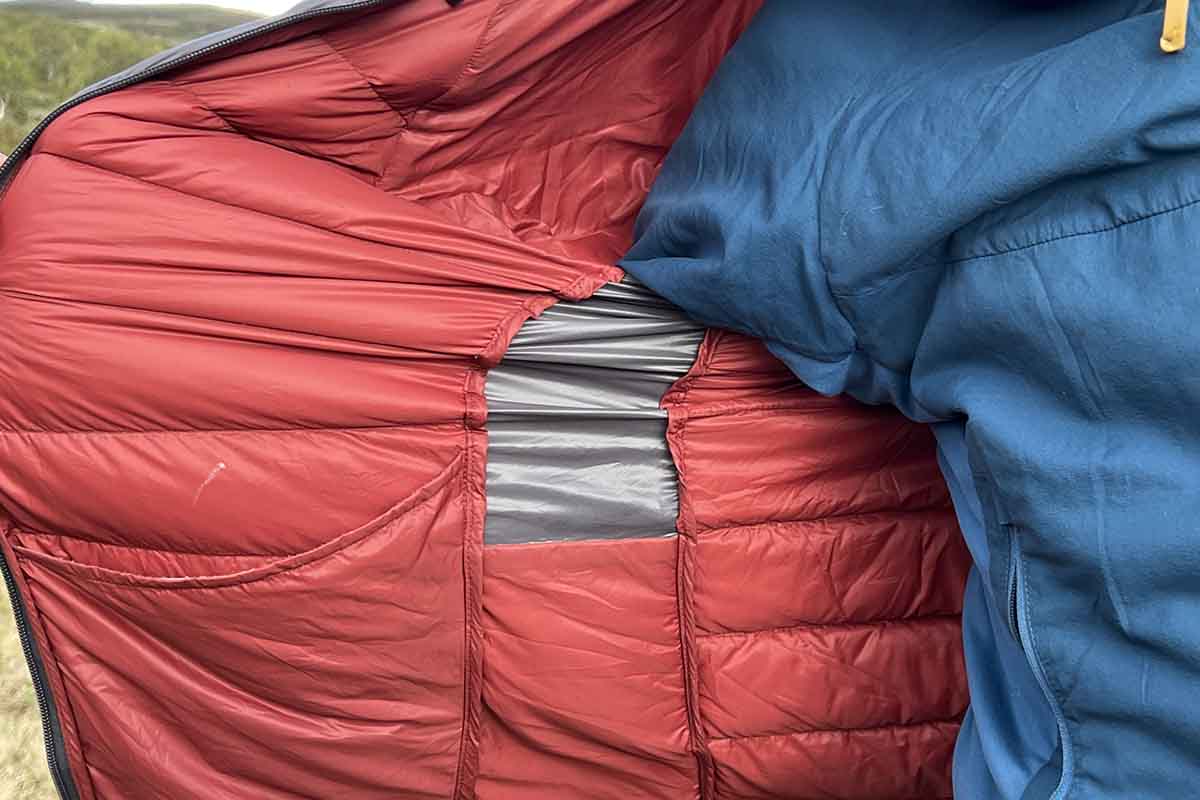
One remark that is important. Under the armpit and the side – the spot where hardshells have a pit-zipp – you’ll just find fabric and no insulation. This is different from what Patizon states on the website. To be honest… I like this non-insulation part since I have the tendency to heat up pretty fast and this prevents it. Next to that: the freedom of movement is excellent.
In the two years that I have been using it, the down has not degraded, no cluttering and it still has its full loft. Also the distribution of the down in the baffles is still 100% ok. The outer and inner fabrics prevent down or small feathers escaping to the outside world. Not all fabrics do this. And yes…. Last winter I got hooked on a thorny branch that ripped a small tear in the fabric on the belly side and next to the front zipper. I repaired it with a Gore-Tex fabric repair patch and now the jacket looks really cool!


One last remark: If you want to buy a new Patizon product your Patizon ReLight Pro Down Jacket has a refund value of € 20.00. But I don’t think when you own this jacket you will ever do a trade in.
My verdict
The Patizon ReLight Pro Down Jacket is a jacket I have genuinely come to appreciate over time. With a weight just under 381 grams and a compact pack size, it is easy to carry and always finds a place in my backpack. The jacket lofts quickly and the hybrid insulation works very well in practice, providing excellent warmth in the core while maintaining breathability and freedom of movement in more active areas. The use of RDS-certified 850 CUIN goose down combined with Climashield Eco insulation is a smart and effective solution.
The recycled outer and inner fabrics feel durable and the PFC-free DWR coating performs well in light snow and damp conditions although lately the performance has dropped a bit. The fit is excellent, the raglan sleeves allow unrestricted movement, and the helmet-compatible hood offers good protection. Thoughtful details such as the merino-lined hand pockets add comfort, while long-term use shows that the down keeps its loft and the fabrics hold up well. The only real downside for me is the small zipper pull tabs, which are not ideal when wearing gloves.
The Patizon ReLight Pro Down Jacket has a retail price of € 345.00 it offers fine value for a high-quality, durable, and well-designed hybrid down jacket. I rate the Patizon ReLight Pro Down Jacket at 9 out of 10 points. At the current moment the jacket is on sale and has a price of € 241.50 which is a steal.
LINK TO THE MANUFACTURER (No affiliate)
Patizon Relight Pro: https://geni.us/PatizonReLightPro
Patizon Exo 100 (the follow up): https://geni.us/PatizonExo100