The Ayacucho Cabrera Mid WP is the first hiking boot from the Dutch outdoor company Bever. It’s designed for day and weekend hikes with a not too heavy backpack. And of course it is possible just to walk the dog when it’s pouring outside since they are waterproof. But are they? Enjoy the review!
- Price: € 159,95 / £ 120,-
- Weight: Men 525,3 grams / 18.5oz (one shoe, 42/UK 8)
- Weight claimed: Not specified
- Sizes: 36-47, UK 4-11 (depending on color)
For those of you who are not Dutch a small introduction to the Ayacucho brand and the Bever company is justified. Bever is with over 40 stores the largest outdoor retailer in the Netherlands. Bever belongs to Yonderland that also operates with 50 AS Adventure shops in Belgium, Luxembourg and France and in the United Kingdom with over 70 Cotswolds Outdoors shops. The group is owned by PAI, an investment organisation from France. With this amount of shops they have a huge reach. It makes sense to have the Ayacucho private label brand. That they started making shoes now too is a logical consequence. That said… they don’t literally make their own shoes but someone else does. Curious?

Ayacucho… Made by… Grisport
It does take some investigation, but quite fast I saw some shoes that resemble the Ayacucho Cabrera Mid WP hiking boots almost perfectly: the Grisport Discovery Mid. After checking I got confirmed that the factory that produces the Ayacucho shoes is the Italian shoe brand Grisport. It is one of the biggest shoe manufacturers in Europe and they produce shoes under the Grisport label but also produce for others. The Bever company is one of them now, but – probably better known internationally – the French Decathlon is already a long time Grisport client. Why is this background information important? Just read on!
Walk into an outdoor shop, head on to the shoe section and you’ll see the answer: there are already a lot of shoe brands available. Do we need another shoe brand? Do we need shoes that look a lot like other shoes? Maybe we as outdoor customers don’t. From a retailer’s perspective this is different; they want a piece of the action, a slice of the cake and in this respect a bigger slice of the cake. What also might be a reason is that the retailer has better or more control on the end product in regards to materials, production, waste management and even maybe durability and sustainability. But more on this later. Now let’s talk about the Ayacucho Cabrera Mid WP.
Weight and size
I put the shoes on my calibrated scale and I measure a weight of 525,3 grams/18.5oz for one shoe in a size 42/UK8. Ayacucho does not state a specification on their website so no comparisons can be made here. The weight is quite normal for these kinds of shoes if I compare them with shoes I reviewed in the past.
Fit
The Ayacucho Cabrera Mid WP is only available in whole sizes and that is a little bit of a problem. I have a shoe size 41.5 which is 26 cm. When I was invited for the introduction of the shoes size 42 was reserved for me. That pair was way too big. So I asked for a 41 but that pair was still a bit large. But I gave it a chance and started hiking with this pair. On hikes near my house and in my daily routine I still had the feeling that the 41 was quite big. So I went to a couple of Bever stores and fitted a size 40. That felt way better with regular hiking socks and I would say that 40 is probably my size. However… with winter socks I was not too sure. So I continued hiking on the size 41.

During the 6 months of daily use of the Ayacucho Cabrera Mid WP I must say that the fit is absolutely too big for its size. From the beginning the shoes are also very wide. That is super if you have a wide forefoot. Normally I like a bit more width in the front but these are really wide… Next to that I noticed that the shoes get wider over time. So when you are going after these shoes after finishing this review, take the time to visit a shop and test for the correct size yourself. Don’t buy them online on the size that you normally wear.
- NOTE: I did ask if this was maybe a preproduction sample issue but I did get real production shoes like they are in the Bever stores.
Ayacucho Cabrera Mid WP Unisex
The Ayacucho Cabrera Mid WP comes in black, olive green and sand brown/light grey (off white to me. One funny thing that happened when I checked in Bever shops for sizing, is that some shop staff was convinced that the off-white pair that I am using was a women’s shoe. In the shop the white ones are on display in the women’s shoe section and the olive green ones in the men’s department. The fit however is unisex.
Both shoes are made on the same last except that the off white version is available in sizes 36-42 and the olive green ones in 39-47. In the last sizing the shoe is also available in black. So if you like me like the lighter color and have that sizing… feel free just go for the ‘womens’ version.

Putting on
Thanks to its wide-opening tongue and an excellent pull loop at the back of the shaft the shoes are quite easy to put on. One remark though: you need to unwind the laces fully otherwise the instep is narrow.

The eyelets on the forefoot are made of nylon loops. The shaft features eyelets that are partly ‘plastic’ and partly holes in the shaft Cordura fabric that are reinforced with leather.
The tongue has a central securing loop to keep it in place. The laces are flat and not very thick. Personally I don’t like them; they provide a lot of resistance when putting the shoes on and they cut too much in my fingers and the cushioning material on top of the tongue. On the positive side: knot them tight and they will not come loose.


The Cordura shaft is very soft and flexible but a big piece of plastic wraps around the ankle and when tying down the laces the heel is fixed in place because of this. The plastic wraparound also provides some support to the ankle.

Information Efforts
As part of any review I always refer to specifications that the manufacturer states on the website or in brochures. The Bever website does not tell a lot so I had to dig deeper. Particularly regarding the waterproof membrane, leather sourcing, and the (lack of) sustainability claims. I reached out multiple times to Bever as well as to Grisport and even membrane producers like Sympatex.
While Grisport was open and helpful, providing some technical details about the shoe, Bever was much less forthcoming. Over a period of five months, my repeated requests for information from Bever — including press contacts in the Netherlands, Belgium, and the UK — yielded little to no clarity. In the end – just before publishing this review – I got some answers but regrettably not complete. So I asked my questions again, but no answers yet…
My goal is – as ever – to give you the full picture, but ultimately, some information around materials and sustainability I don’t have fully. But let’s start with what I do know.
Construction and materials
The upper of the Ayacucho Cabrera Mid WP consists of a combination of mainly nubuck leather and synthetic Cordura material.
Not stated on the website but from Bever I got back that the synthetic parts are all virgin – non-recycled – materials. The leather is European chrome-tanned bovine leather (the flesh side of the hide, not the top grain outer layer) sourced from certified slaughterhouses. All chemicals used in the production process comply with the Zero Discharge of Hazardous Chemicals (ZDHC) Manufacturing Restricted Substances List (MRSL) and meet the requirements of the Registration, Evaluation, Authorisation and Restriction of Chemicals (REACH) regulation.

The tongue is partly leather and is connected to the shoe with synthetic materials keeping material layers on top of each other to a minimum. This results in more comfort. Comfortable is also the soft synthetic material that surrounds the top of the shaft. Protective material surrounds the shoe but the protection at the toe box is more like a small bumper and could be better if you’re the off road hiking type.
Waterproof and breathable
The Ayachuco’s are waterproof and breathable because a membrane liner is part of the shoe construction. Since I am a curious guy, I asked what waterproof and breathable membrane is hiding behind the Waterproof logo. No answer on this from Bever, but from Grisport I was first told it was a membrane that was produced by Sympatex. So I asked Sympatex what membrane it was but they could not confirm that the Ayacuchu has a Sympatex made membrane. So I asked Grisport again and soon I got the answer that it was something different and I got a super datasheet in the mail.
In this data sheet there was almost everything I needed to know from abrasion test results to breathability results. If you are curious…. sorry, I can’t publish that because the document clearly states that without written permission I can’t publish the data and I don’t have that and I don’t want a lawsuit. But investigating further I learned that the membrane is most likely a Te-Por membrane that is produced by the Italian Pidigi S.p.A. company.

Hydrophilic membrane
The membrane itself is made from Polyester and it is a hydrophilic membrane. Hydrophilic means that water molecules are passed through the membrane because of the fabric properties and not because the membrane has tiny holes – a microporeuse membrane – like for example Gore-Tex.
The construction of the membrane liner sits like a sock inside the shoe. When walking through puddles, walking a long time through wet grass or passing a stream, the shoe (not your feet) can get wet and kind of heavy when not well maintained. It is of key importance that the leather is treated regularly with a water repellent material. More on this in the How to video I made in Shoe Care.
- NOTE: On the website Bever states that the shoes are not 100% waterproof because “during prolonged walking in rain or wet grass, they can still become wet on the inside.” More on this later.
About the Nubuck leather
In my quest for information about a product, as mentioned above, I always look at the website to see what the manufacturer tells about the materials. With the Nubuck leather something funny is going on. Bever states that the upper is made of hydrophilic Suede.

The word hydrophilic means that a material – in this case the Suede – attracts water. The most obvious material we all know that is hydrophilic, is salt. I think I know what they mean. Leather is porous. Take for example a chamois (leather) that we use when cleaning the windows. A chamois is porous and absorbs water. It is its sole purpose.

Shoes made of leather are mostly treated in a way that some moisture can be absorbed; it is a pro in relation to climate and comfort. But to call suede leather hydrophilic is a bit different. The last thing I want is a shoe that absorbs water because when it gets wet, it blocks the membrane and it will make your feet get cold. I guess they mean the word hydrophobic; a material that repels water like the Durable Water Repellent layer on the outside of a rain jacket or your shoes.
Ayacucho Sole construction
The Ayacucho outsole is from the Italian Vibram. Bever – nor Grisport – website states what Vibram outsole it is. I asked Bever and in the end they stated that it is the Vibram 360 Outdoor outsole, a 100% rubber outsole produced by Vibram exclusively for Grisport.
The outsole features large, quite deep lugs. The heel on the Cabrera Mid WP is not articulated. Cushioning is provided by a Polyurethane (PU) midsole. The PU has small air bubbles – some visible from the outside – for an even smoother hike.

The removable insole is made of Polyurethane with a textile layer on top for added comfort. Overall, the sole construction aligns with a lightweight, easy-going hiking boot. While torsionally quite rigid, the forefoot flexes comfortably to enhance walking comfort.
Sustainability and Repairs
Bever – the company behind the Ayacucho – profiles itself as very conscious about the welfare of our planet. And that is fine. Also about the brands and the products that they sell, there is always a lot of attention to how things are manufactured, labourers welfare, animal rights (in case of down and wool) and caring and repairing. Bever does have an in house repair department and they buy in and sell recycled goods and second hand gear. Regarding the Cabrera Mid WP however we as consumers get very little information from the website.
The website only states that buying the shoe contributes to the 1% for the planet organisation. That is – maybe – fine, for sure, but I expected more.

Contacting the Bever resulted after all these months only in the information that I wrote above: chrome tanned leather and virgin synthetic materials. Regarding the outsole, Grisport explained that this one is a bit more durable than the outsole they use for their own shoes. At first they stated that the lugs are solid and not filled with the PU-midsole material. This would make them more durable.
Cutting the boot in half
When I cut one pair in half, I discovered that the lugs on the Ayacucho are filled with midsole material, just like the cut through Grisport I have. There is a little difference: the rubber on the Grisport is 0.2 mm thick while I measure 0.3 mm on average on the Ayacucho. Checking with Grisport they state that the lugs are indeed not solid but the lug wear thickness should be 0.4 mm. Ok, here we have a minor discrepancy.


Bever nor Gripsort can tell me what kind of DWR-treatment is applied to the shoe. Is it a sustainable non-PFC containing DWR or is it a DWR containing PFC’s? That is information I want to know when I am considering new outdoor gear.
Outsole replacement
Regarding the outsole, at first Bever and Grisport tell me the outsole can not be replaced because the outsole on the Ayacucho is injected to the shoe’s upper and thus is an integral part of the shoe design. Talking to a specialist shoe repair shop in the Netherlands and to Vibram, they stated that the shoe can be resoled by replacing the outsole if the midsole is still ok. Checking with Bever they confirm that this is possible. Might be worthy to mention that on the Bever website…. All in all: it is good for sustainability!
One last remark: I wrote that Bever does buy back products for reselling. On the website they have a long list with brands and articles that they will buy. Shoes, any shoes – while being perfectly serviceable, repairable and resellable – are not on that list. Do I need to say more…

Ayacucho Cabrera Mid WP in Practice
I have been using the Ayacucho Cabrera Mid WP almost daily for six months intensely. Although the size is not correct for my feet, they have proven to be very comfortable. It is one of those shoes that is comfortable for almost every occasion. In that respect it is a nice job that Bever – or should I write Grisport – has done with their first shoe.

The Ayacucho comes very close to another famous shoe: the Lowa Renegade that I reviewed earlier. Like the Renegade the Cabrera is a shoe that is suitable for walking the dog to day- and weekend hikes with a small, not too heavy backpack. I could see myself even taking it up into the mountains for a non-technical hut-to-hut hike with a 30-liter backpack with a weight of around 12 kg in it.
Don’t expect too much ankle support from the mid-height Ayacucho’s. I noticed that the shaft lost a bit of stiffness quite fast. Yes, it makes the shoe even more comfortable but it loses a bit of support. The shaft effectively protects feet from sharp stones and rocks though.
Grip outsole
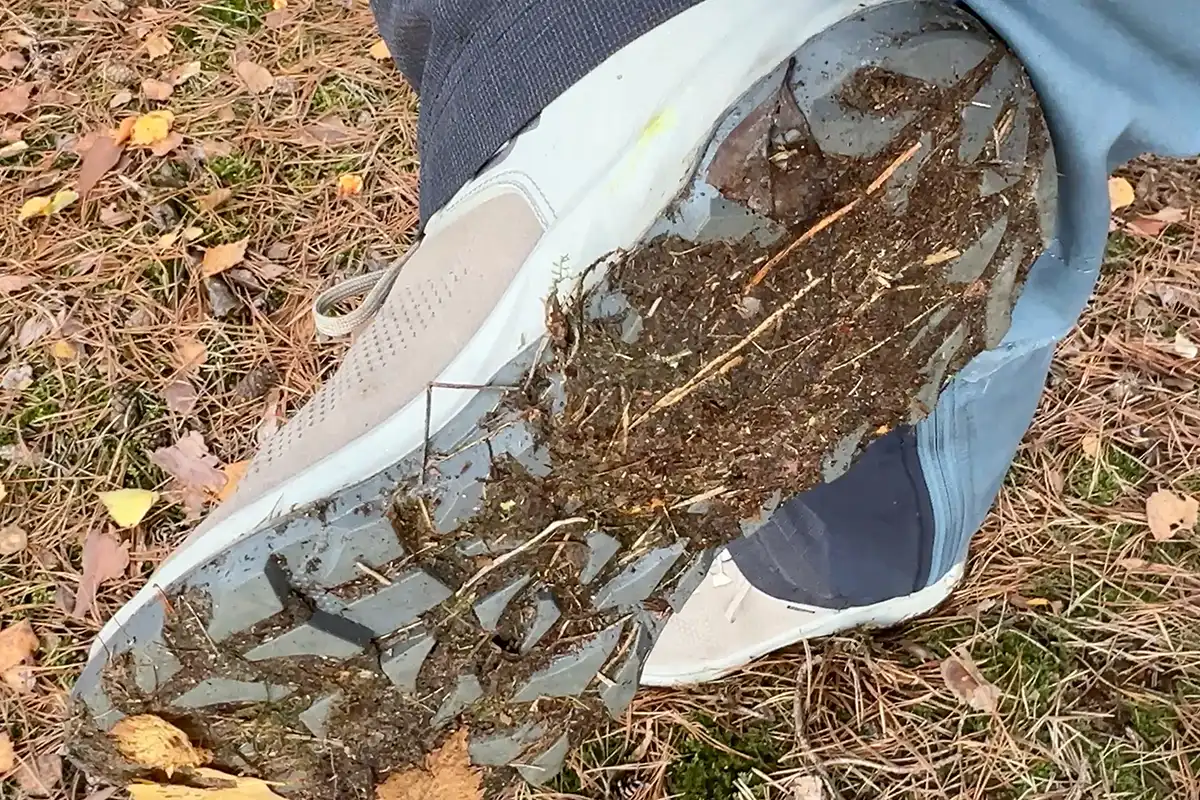
The outsole generally provides good grip in dry conditions. In wet conditions, it doesn’t fully convince me. Walking down wet rocky trails I felt the sole sliding and crossing a stream almost made me slip in it. Descending on loose pebbles doesn’t feel very secure either. The lugs are fine but I miss the articulated heel. Walking through real Dutch mud and clay makes the lugs fill up with mud and it doesn’t come out easy by itself. The sole is relatively soft, so you can feel sharp stones and pointy rocks through it.

The damping of the midsole – praise the air bubbles! – is fine and I never had feet that felt fatigued. The cushioning is super comfortable. The toe cap could do with a bit more protection; the leather is a little bit worn because of rocks. The Waterproof liner offers a wading height of about 9.5 cm /3.7 inch, and the boots have proven to be waterproof. The outside – the leather and the Cordura -, shed water effectively when walking through wet grass or shallow streams.

Sweaty Feet?
Important in relation to sweaty feet is the time of the year that I have been testing these shoes: late autumn and winter. So far these shoes have not seen temperatures above 15 °C so I do need to do an update on that later.
During the ‘winter’ testing the shoes held up fine. Due to the fact that they are on the large side I could use double socks in Sweden with temperatures going to -10 °C. Not that they are winter boots, but for a short walk-the-cat (see this video) it was fine. Under normal conditions I didn’t find the shoes very breathy and I did get sweaty feet after a while. In colder weather that leads to toes getting cold.


The fact that I experienced the shoes being quite damp from time to time could also be the consequence of the fact that Bever states that they are not 100% waterproof “during prolonged walking in rain or wet grass, they can still become wet on the inside.” In this period of the year we have a lot of that. And snow – wet snow – hikes probably don’t help. However… a) I talked to a membrane specialist she never heard about this and b) the Waterproof logo on the shoe has to be taken with a pinch of salt. Or should I write that it is just misleading?
Verdict
The Ayacucho Cabrera Mid WP Hiking Boots are a comfortable, lightweight, and versatile hiking boot aimed at casual hikers, dog walkers, and light weekend trips. With a weight of 525.3 g per shoe (UK 8), they sit in the mid-range category, offering good cushioning and support for day hikes or everyday outdoor use.
Comfort is the standout feature: the soft nubuck and Cordura upper, PU midsole with air cushioning, and wide fit make these boots easy to wear straight out of the box, with little break-in required. For hikers with broader feet, the roomy toe box is a definite plus. The waterproof liner performs well in normal wet conditions, and the boots are easy to put on thanks to a wide tongue and pull loop.
That said, the Cabrera Mid WP has notable limitations. The sizing runs large and only comes in whole sizes, so testing in-store is essential. Grip on wet rocks, wet grass, and loose gravel is moderate, and the non-articulated heel reduces downhill braking security. Breathability is also average, and the waterproof system may struggle during prolonged exposure to very wet conditions. Take the Waterproof logo with a pinch of salt.
Beyond performance, my investigation into the shoes revealed a gap between brand claims, transparency and expectancies. Bever markets sustainability as a core value, but repeated inquiries over five months about materials, waterproof membranes, and sourcing received late and minimal responses. While the boots are comfortable and functional, there is no clear evidence that these shoes offer sustainability advantages over similar mid-range hiking boots. This is an important factor for buyers who care about sustainable manufacturing and material sourcing.
For its €159.95 / £ 120,- price point, the Ayacucho Cabrera Mid WP offers solid comfort and everyday usability, but it doesn’t quite reach the performance level of some established hiking boots in the same category and therefore I rate it at 7.5 points out of 10 total.
Information:
- The Netherlands: Bever
- UK: Cotswolds
- Belgium: AS Adventure